


你最担心的是什么?
It’s probably hard to choose just one. Cloud. Remote workers. All those devices. Or one big breach.



There’s plenty to keep you up at night.
Hybrid workplace or campus
More and more IoT devices
Vendor lock-in

Protect your network from edge-to-cloud with Zero Trust and SASE.
Now you can embrace the business and operational advantages of cloud while maintaining high levels of security. Here’s how.

Establish a Zero Trust and SASE strategy
It’s important to use a network that has full visibility, control, and enforcement with a built-in foundation for Zero Trust and SASE (secure access secure edge) frameworks.

Move away from VLAN traffic segmentation
Zero Trust ensures that the same controls applied to campus or branch networks, also apply to the home or remote worker. That means no more manually generated VLANs that are confusing and risky. And real-time identity-based access control consistently protects the network from edge-to-cloud.

Integrate your Zero Trust/SASE framework with your security ecosystem
As more applications move to the cloud, organizations need to think about extending their current security architecture into the cloud without redoing what they currently have (and increasing risk). It’s best to pair network-enforced, identity-based access control and tight integration with leading cloud security providers like Zscaler, Netskope, Check Point, Palo Alto Networks, and others.

Architect your secure Edge
As remote workforces accelerate cloud migration, network security requirements need to shift. Forrester’s引入安全与网络服务的零信任边缘模型向您展示如何。
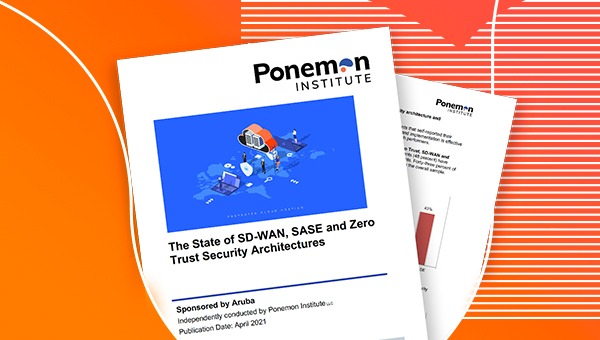
The state of SD-WAN, SASE and Zero Trust Security architectures
Ponemon Institute在全球调查了1,826名安全和网络从业者,发现71%将在部署SAS架构的SD-WAN和云提供的安全性时选择一位最佳的供应商。意思,受访者不想被锁定到一个供应商中。阅读其关于网络和安全的未来的其他结果。




使用Aruba ESP自动化和保护边缘


See how Aruba ESP can help
Know what’s on your network and then ensure that the same controls applied to campus or branch networks, also extend to the home or remote worker.

网络访问控制
- Agentless policy control and automated response
- 动态强制访问权限
- Secure access for guests, IoT, and BYOD


Unified threat management
- Fully integrated attack prevention
- Least access and micro-segmentation
- Context-aware control


Related resources